


People often discuss how public contracts with charities do not get increased inline with inflation. This leaves charities struggling to pay staff, rent and utilities as they’re expected to do the same with less in real terms.
But what about grants?
Do foundations and other grantmakers increase the sizes of the grants they make? Do philanthropists acknowledge that you can’t get a Freddo for 10p anymore? Short answer: not usually.
But more interesting, is why.
Are grant sizes keeping up with inflation?
Our new dataset of UK grants has let us properly answer this question for the first time. We have gathered the majority of grants from the past 5 years, direct from funder and recipient accounts.
We tracked the median grant size of the 3,596 funders that published a grant list in both 2021-22 and 2024-25.
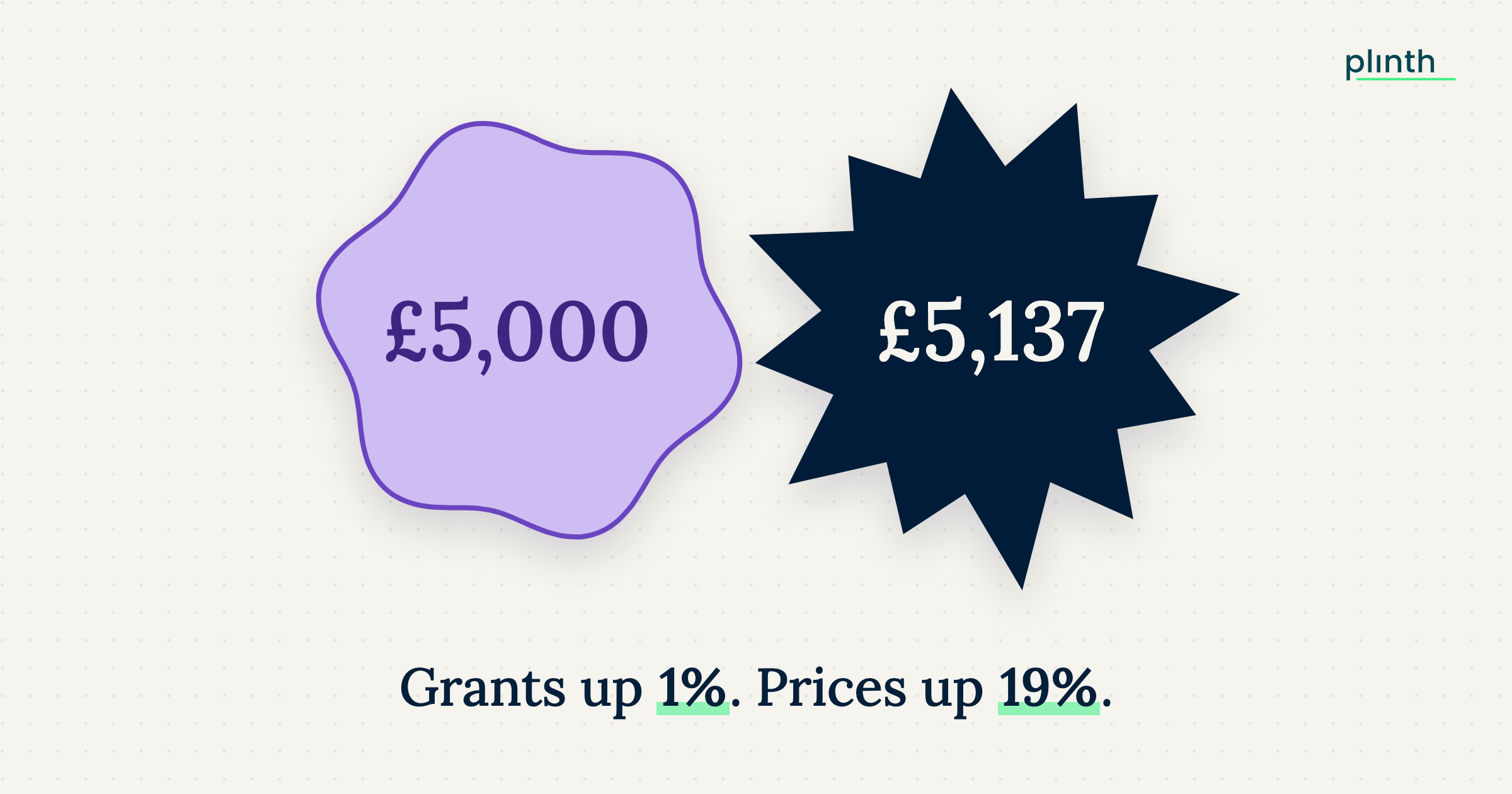
In this time, inflation was 19%. The typical grant from a typical funder increased by just 1%.
At 14% of funders, the median grant was exactly the same.
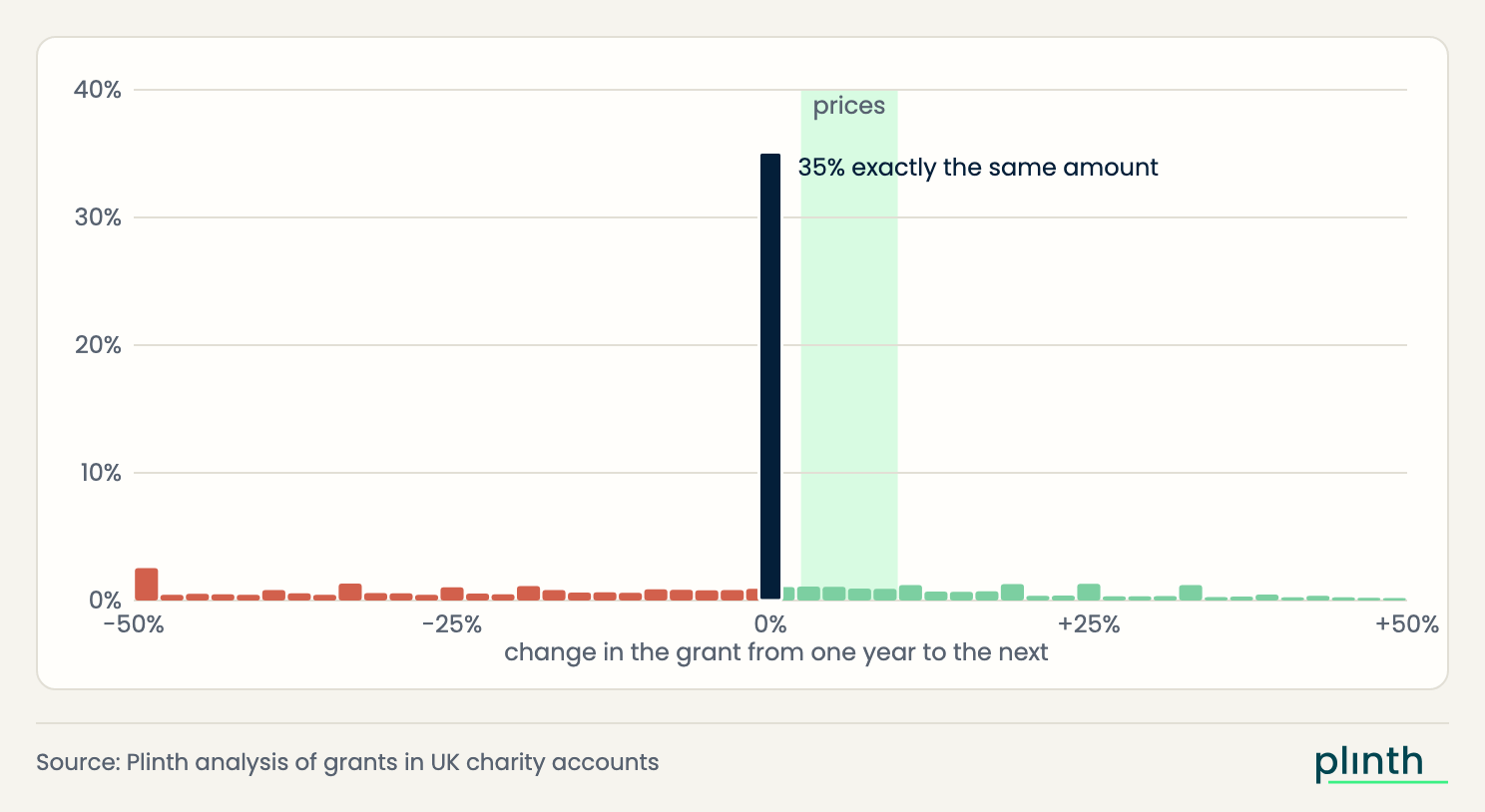
And if we look at funder giving to the same charity in consecutive years, 35% of the time it was for exactly the same amount.
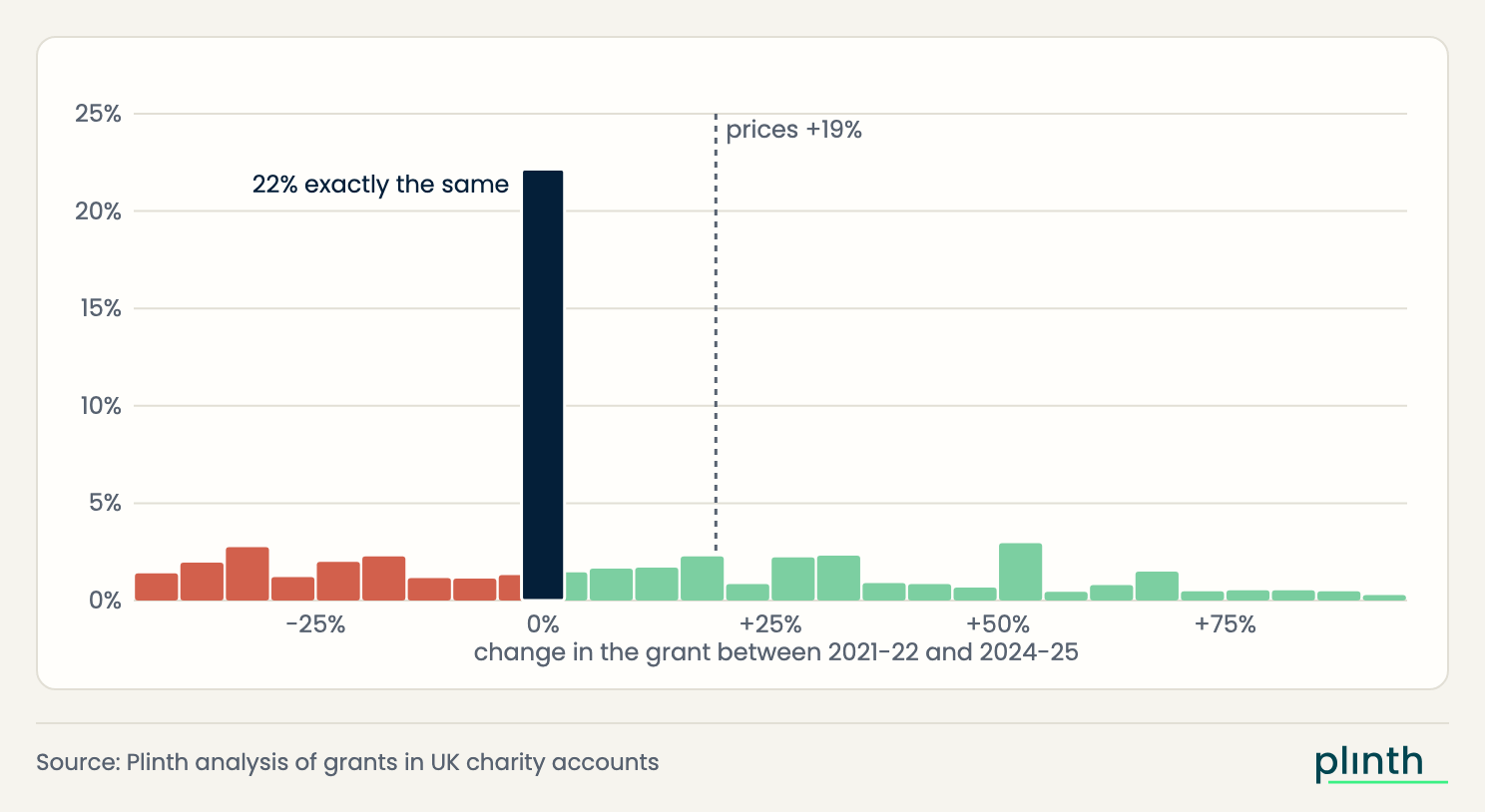
Of course some of these might be a multi-year grant paid annually, so we looked at just those where there was a gap in funding, and it’s still the same kind of pattern:
Why:
Aside from the madmen at Asda, Freddos have jumped up in unpleasantly large 5p increments. Grants are the same.
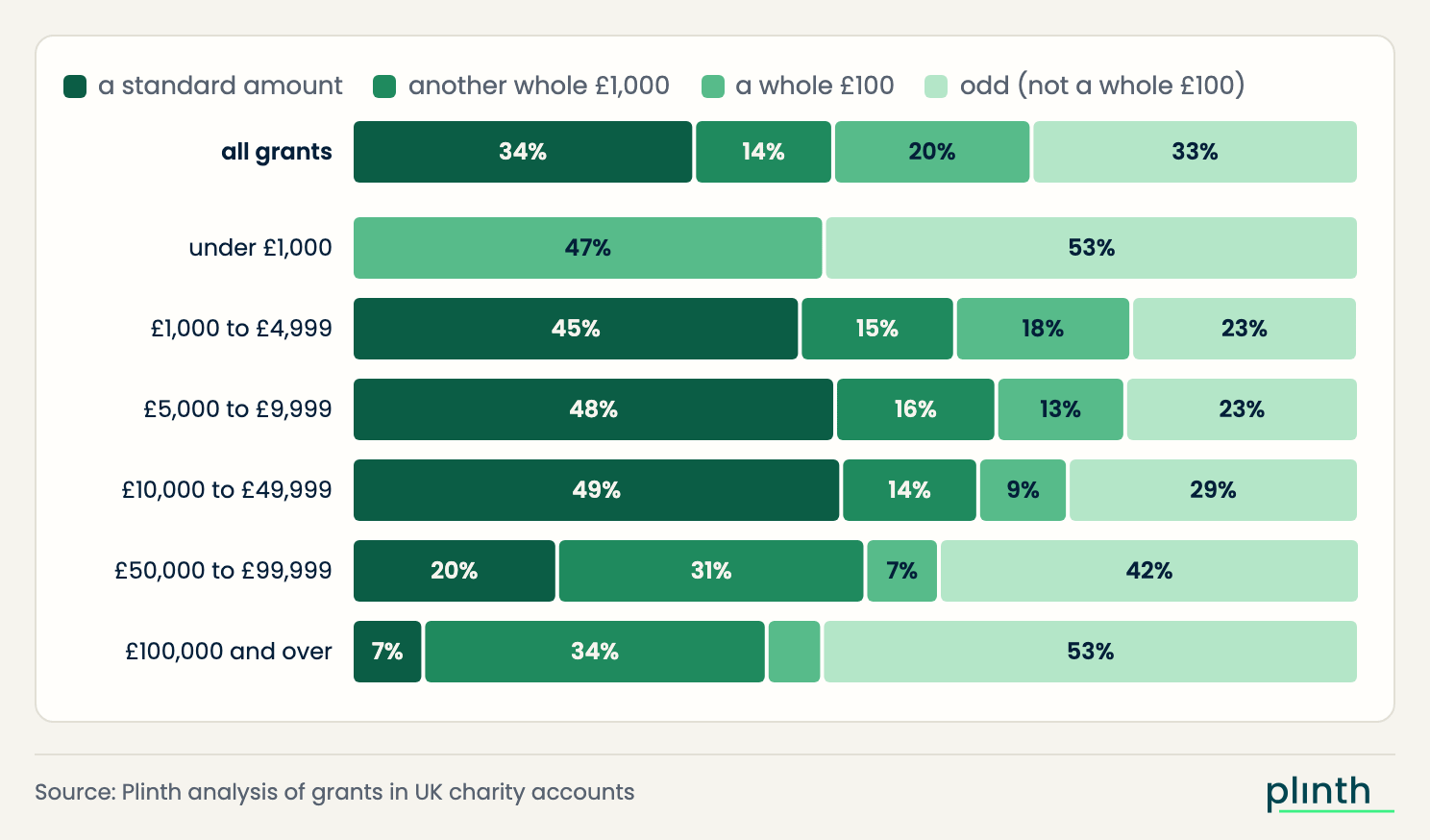
People like giving out grants in nice round numbers. For grants under £50,000, the majority of individual grant amounts are exact multiples of £1,000 or £2,500
You can see the effect most clearly if you plot the number of grants against grant size. It’s not a nicely sloped curve, it’s a staircase:
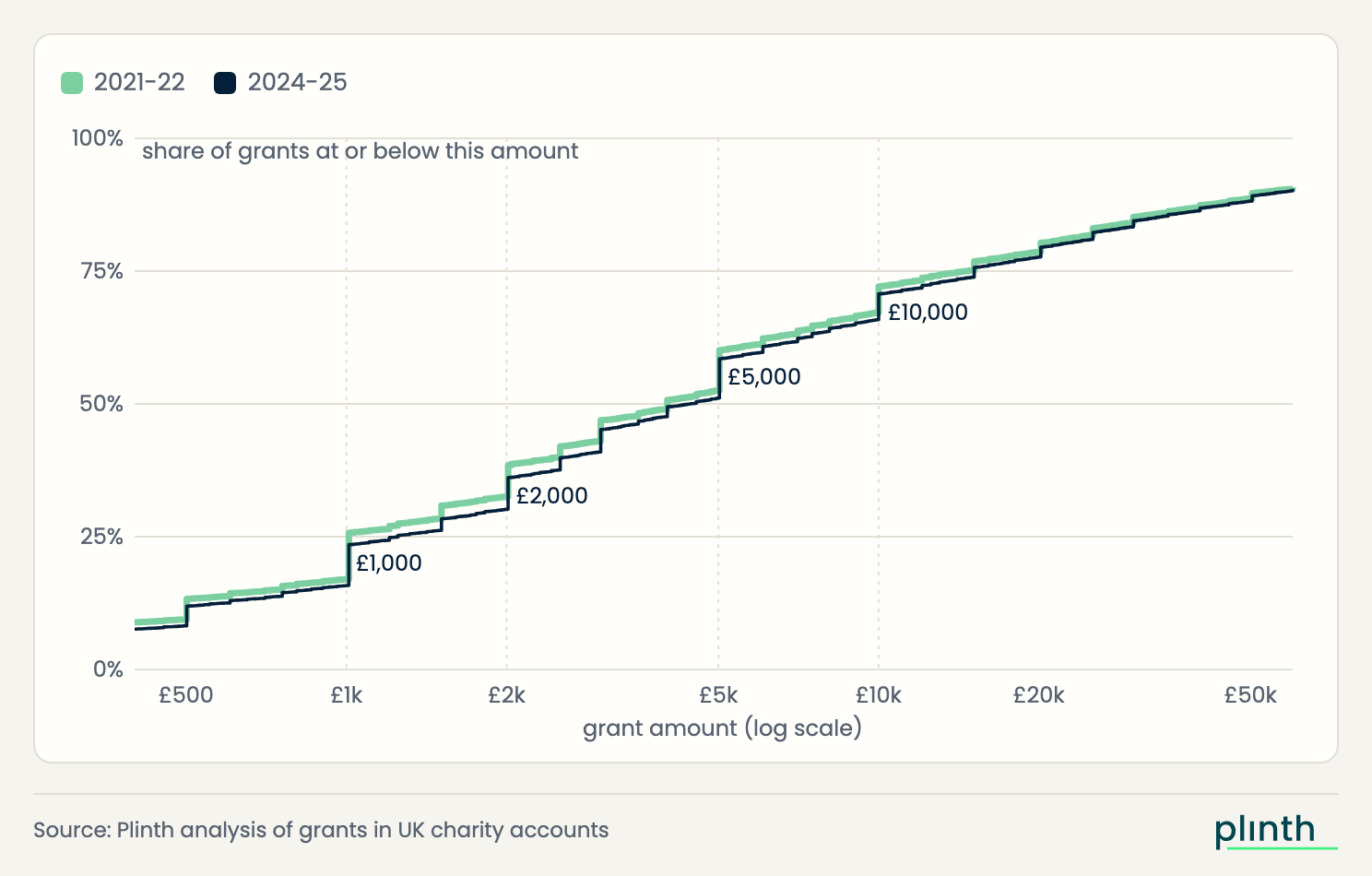
When prices have gone up by 19% over 3 years, that’s purchasing power charities are losing directly, because of the attachment to the appeal of easy addition.
Jumping a step
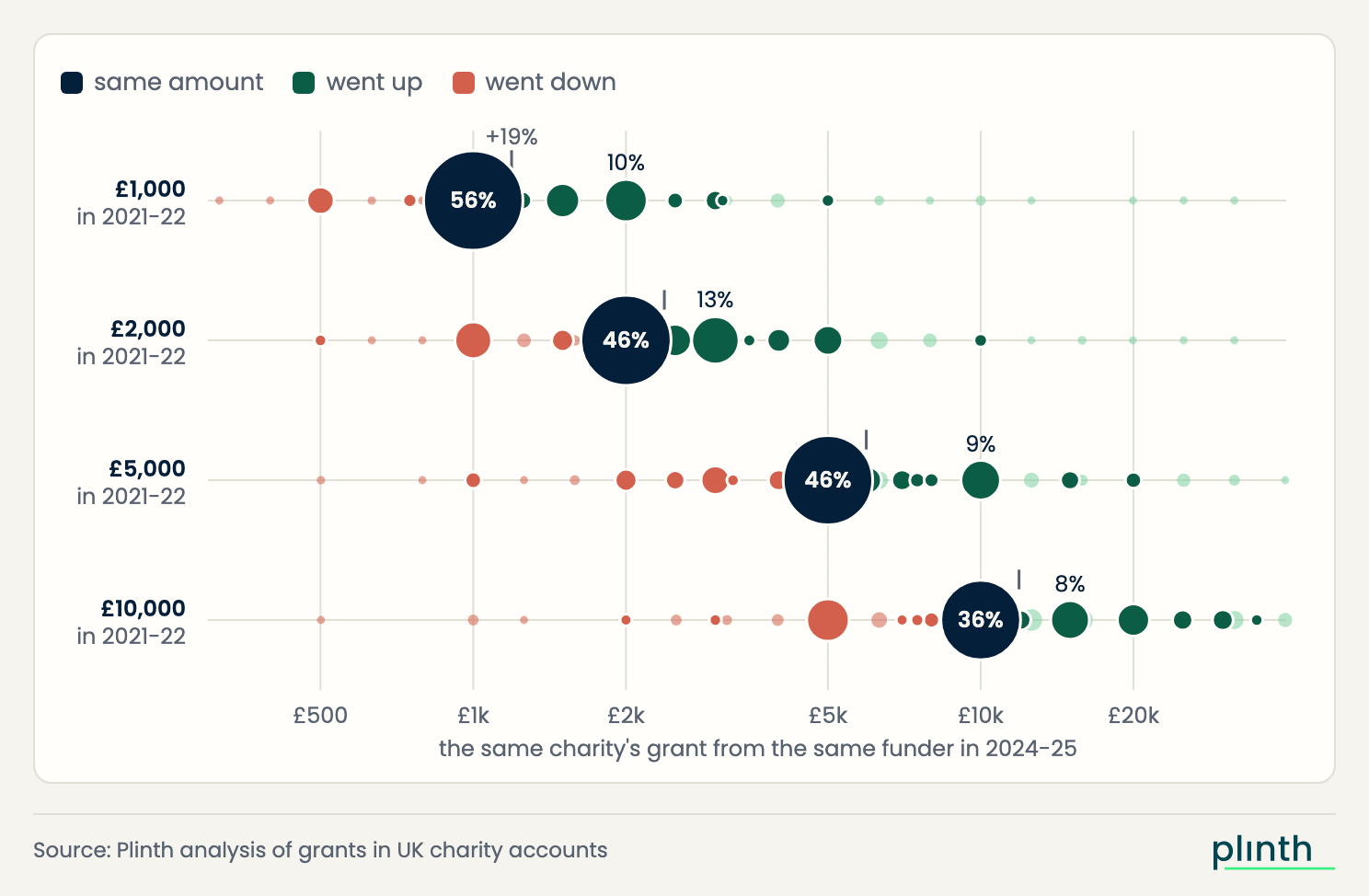
Some funders have internalised the cost of living increases, and have done more to increase their grant sizes.
But interestingly, the way they most commonly do it, is by jumping an entire step — going from £1,000 to £1,500 or £2,000. Of the £1,000 grants that were increased, two thirds went up by multiples of £500, most to £2,000. 171 funders moved up a “standard step”, from £1,000 to £2,000, £5,000 or £10,000.
What’s going on with the money?
If the grant sizes are decreasing in real terms, does that mean the amount of funding is also falling?
For a typical funder, yes. The median funder gave 12% more in cash in 2024-25 than 2021-22, but that’s a cut of 6% in real terms.
If you add up total funding, no. The biggest funders, particularly Wellcome, Great Ormond Street and Arts Council England increased their funding enough in real terms to more than make up for the median — 18% increase after inflation.
But leave out the top 10, and everyone else gave 11% less in real terms.
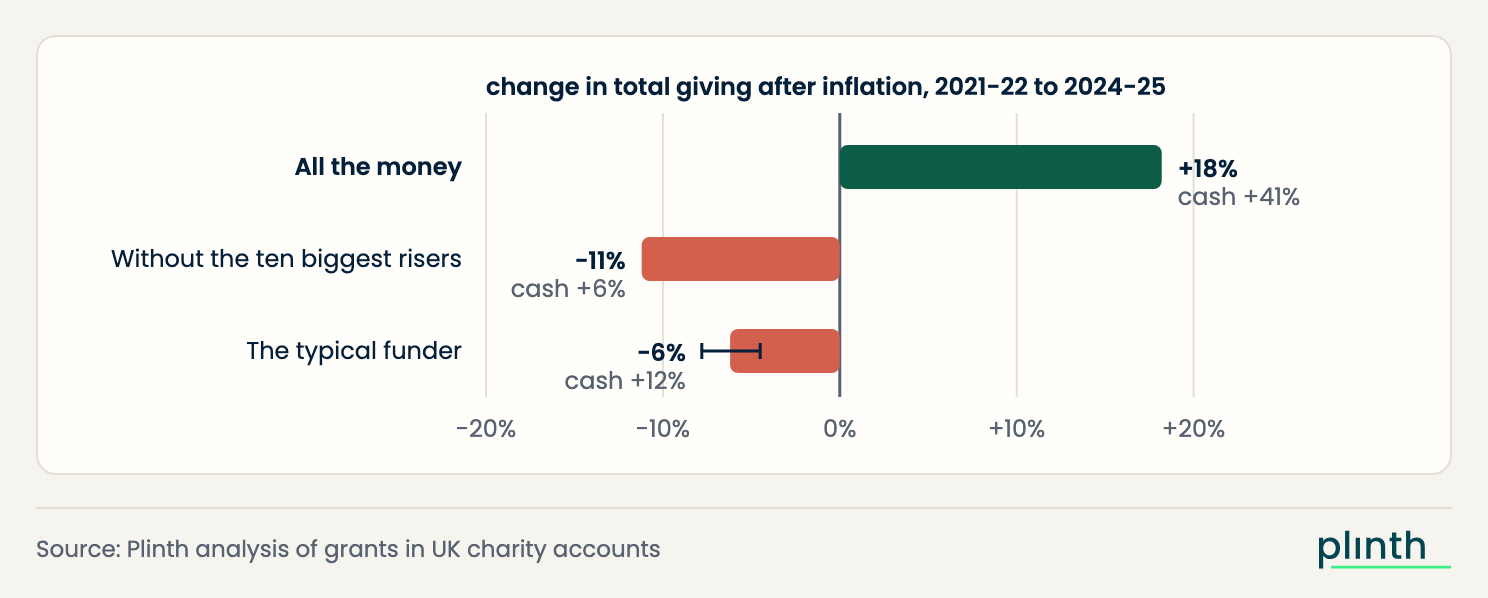
And interestingly, even funders whose giving grew mostly didn’t turn to bigger grants. They typically give to more organisations, and increase the size of their grants only at the largest end.
So it’s all a bit complicated. In real terms, there’s more funding, but most funders are shrinking. Typical grants are shrinking, but the big funders are growing.
Fund odd grants
This is an extremely niche recommendation. But we think funders should deliberately give grants in weird, odd amounts.
If you deliberately abandon the round numbers before inflation hits, we think you’ll be less inclined to anchor to them when prices go up, and more inclined to give uplifts to maintain their purchasing power.
It’s pretty arcane, but the alternative seems to be grants that drift in value without any real reason.
There’s actually some evidence in the data: funders that grant odd amounts are more likely to uplift with inflation already:
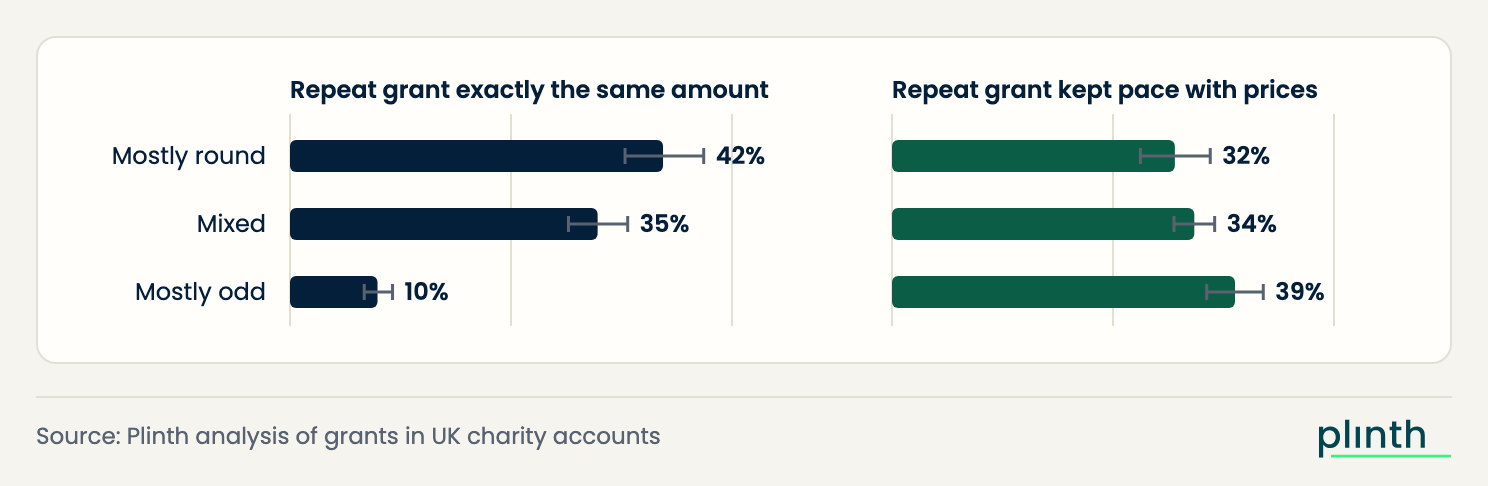
This is probably correlation, not causation, and likely because “mostly odd” funders are explicitly tracking the costs for a charity. Which, well is probably the point we’re making. The amount of a grant should be the result of a calculation, not a convention.
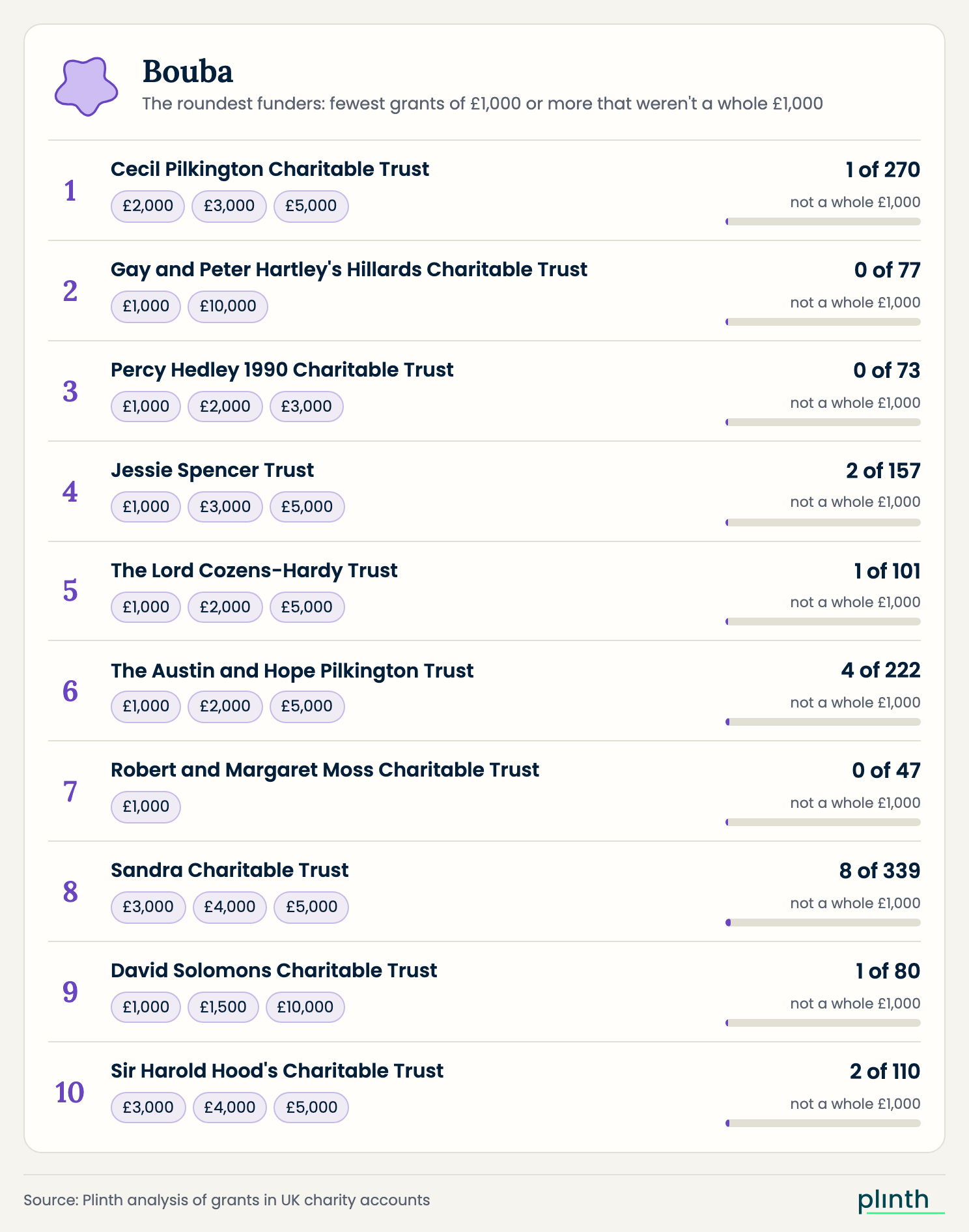
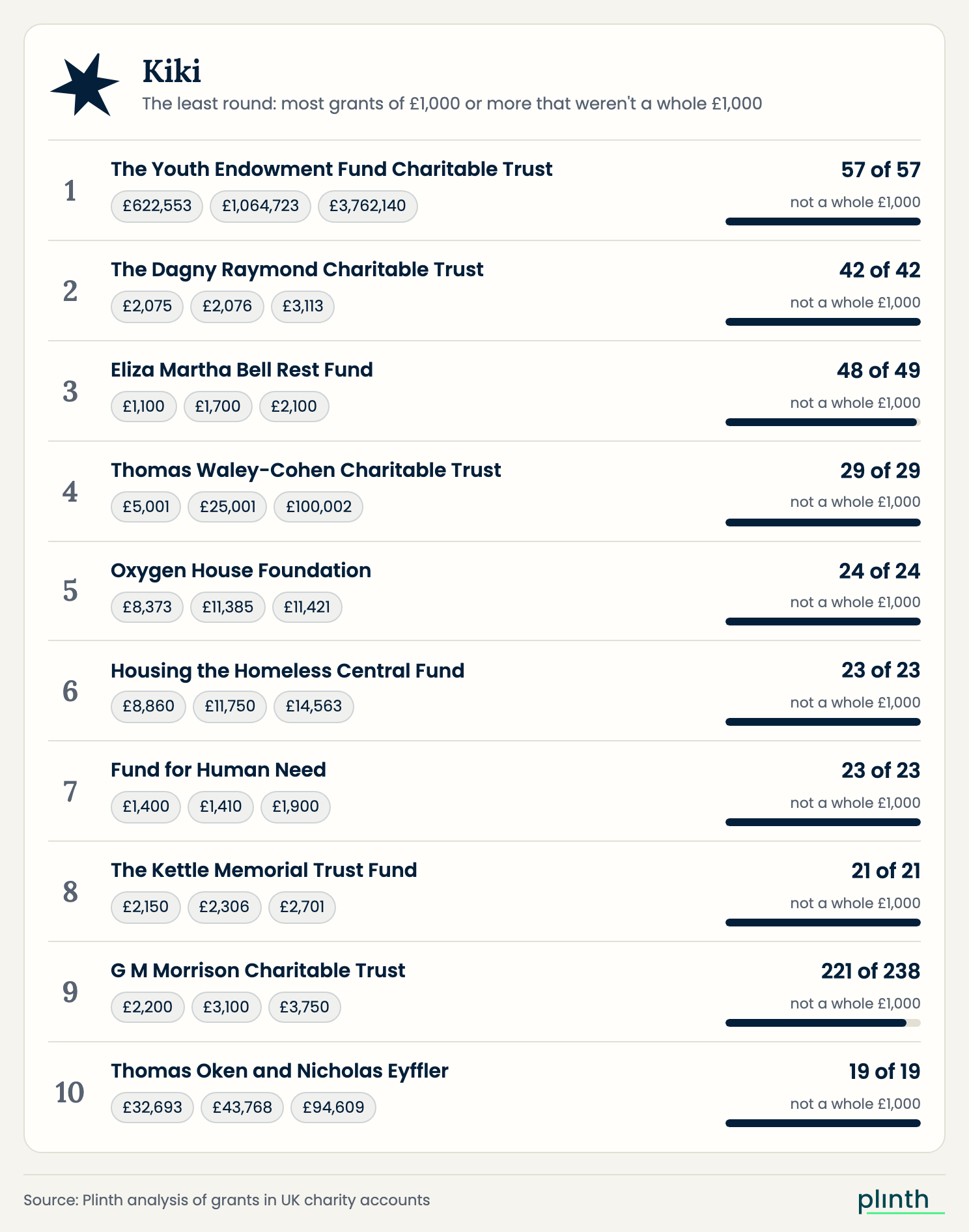
So to complete this, we’re finishing with the most obscure ever ranking of grantmakers: are they bouba, or are they kiki?
Bouba top 10
Kiki top 10
PS
The Thomas Waley-Cohen Charitable Trust deserve a particular mention. They don’t fund round numbers. They fund round numbers +1. That’s not quite what we meant, we don’t understand it, they probably shouldn’t be in this table, but we do love it.